

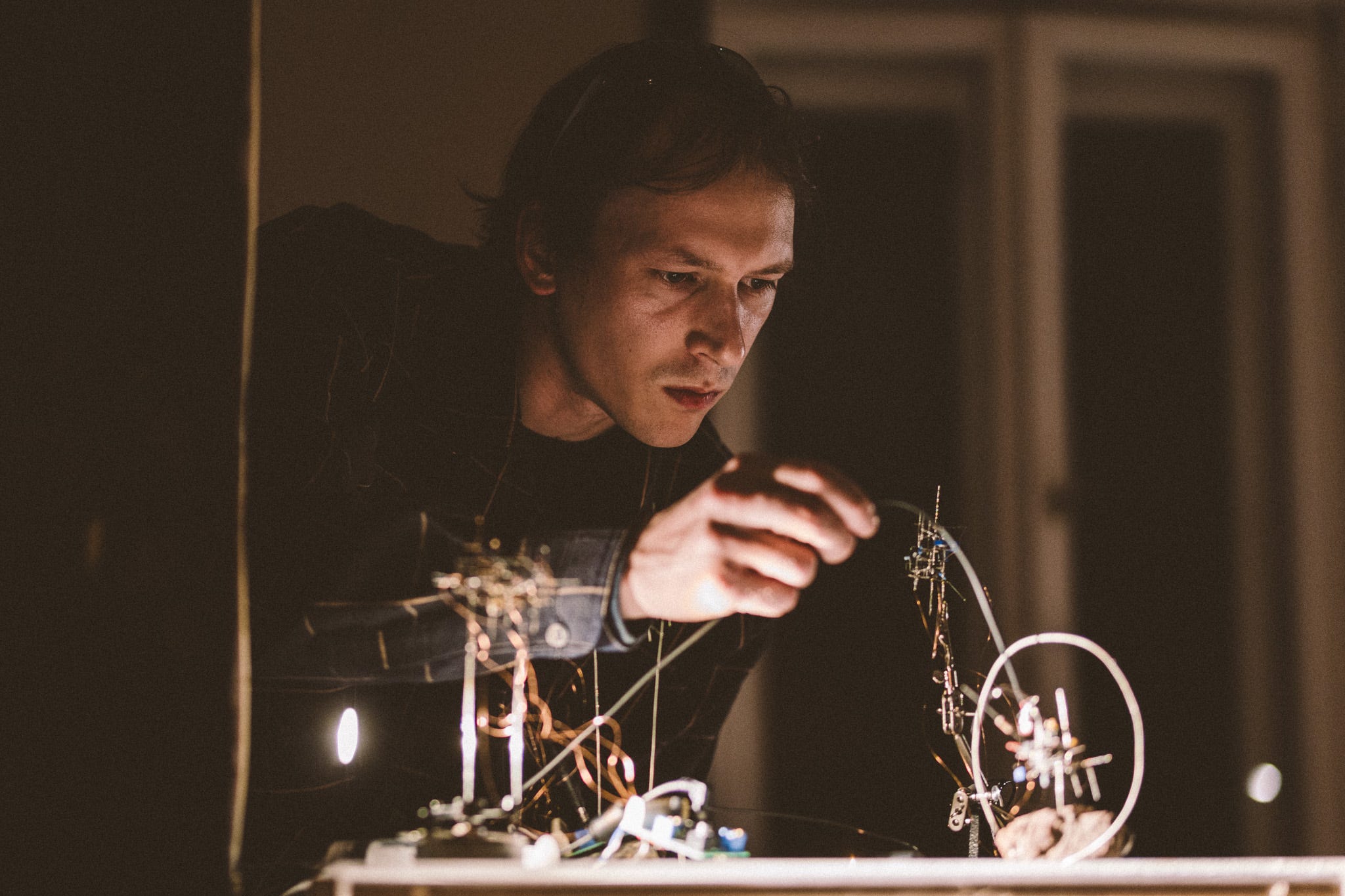
A murky room where walls gobble up all the light. A figure who drifts slowly and gracefully. Soon, a drop of water breaks free from a medical syringe, falling right onto a primitive electronic circuit. And suddenly—a sound is born. The oscillating squeal, plain and direct, is occasionally interrupted by an electronic chirp resembling birdsong. The setup is clinical yet arcane: a collection of gleaming objects that poke in all directions. Bulky mounts bear the weight of bristling wires, hollow cones and rubbery cables. Equipped with humble tools, the quiet tinkerer resembles a 21st-century alchemist, transmuting not precious metals but unpredictable and bewitching resonances. The close-up of his purposeful actions appears on a screen behind him. A loud zap rings out—a spark lights up the room. And another. Time slows down and collapses in on itself…
When I was at school, my least favourite subjects were chemistry and biology. Both seemed dry and technical, with no experiments in sight. Both were taught by young teachers who had perhaps not yet found their modus docendi: one that could ignite interest in photosynthesis and states of matter while taming a herd of rowdy teenagers. Or I simply had better things to tend to. If only the performance from the 2026 Klang Festival had somehow found its way into our nauseating pastel green classroom…
That tinkerer turned out to be Adomas Palekas, a Lithuanian sound and bio artist and instrument builder. His practice invites non-human agency—such as organic and inorganic matter, microbial metabolism and chemical reactions—into the act of sounding. He builds his own instruments and interfaces to accommodate the instability that shapes his performances. Palekas has presented his work at European festivals such as Oscillations, Archipel, Rewire and Gaudeamus, and at the Venice Architecture Biennial. A graduate of the Institute of Sonology, he is now a research associate there, investigating microbial voicing and listening.
Once the set ended, I knew I had to interrogate Palekas about all the magic (aka science) that he’d worked. It was a matter of a few rather summery months before the video call materialised. Below are my findings from a conversation about his early love of science and DIY, and about the risk-taking and fragility at the heart of his performances. Water, as it turns out, can be the beginning not only of life but of sound. We also discussed his community-building practice and the openness it invites, be it social or musical.
Marat Ingeldeev: As a former chemistry and biology sceptic, I have to ask: what drew you to the world of natural sciences?
Adomas Palekas: I think a formative influence was my first chemistry teacher. The irony is that my entire family—and I’m the youngest of three siblings—had struggled with chemistry growing up. So when it came to classes, everyone assumed I’d fail too. It almost became the one subject with zero pressure. I went in expecting not to understand anything, but because of that teacher, everything changed. She was a remarkable woman, quite bold, who would demonstrate experiments for us. We would do explosive reactions, which I found inspiring as a teenager: the danger of it, the reactivity, how everything can get violent but can also be controlled. It piqued my interest so much that it became the starting point from which my fascination with natural sciences grew.
MI: Given that your practice involves building instruments, soldering and handcrafting objects, I’m curious where the DIY impulse came from.
AP: It came from my grandfather, who was a mechanical engineer. I picked up a lot of that DIY craftiness from him. Not that he would make objects or art, or anything like that. It was very, very practical: just fixing things, digging through stockpiles of old components. He had these endless shelves where there was one little screw for everything, for any occasion.
MI: And what was so enjoyable about that early hands-on work?
AP: I enjoyed, right from the start, that it never came as part of any formal education. It was always very informal. Even before I started tinkering with electronic DIY, I was skateboarding as a child, building ramps out of wood and working with metal. Together with my grandfather, I repaired my first-ever synthesiser, a Soviet one. The first electronic effect I made was a fuzz pedal for my bass guitar—and that was also made with him. The beautiful part was that he didn’t really understand it either. He wasn’t a professional in electronics, but he grasped the whole principle: how things should work and what to look out for. And so we learned together, which was very, very nice. From there it was just individual curiosity: trying things out, seeing them fail, making them work, troubleshooting.
MI: Apart from the bass guitar, did you play any other instruments in your teenage years? And how did you find your way into sound art and experimental music?
AP: I went to music school for seven years as a child, playing classical piano. At that stage, it felt almost completely disconnected from what I actually liked in music: classic rock and metal. But then I thought I wanted to play this music, so I started trying to arrange pieces myself. The whole music practice—how I see it now—really started when we formed the first band with my classmates. That was the first time I tried to improvise, to play with other people. Later, I became interested in synthesisers. I had the time, but I didn’t have much money, so I figured I’d just try to make something myself. I would change a component, then another one, customising and understanding what did what, learning through trial and error.
MI: But you ended up studying natural sciences at university, right? Did you ever consider pursuing them professionally and becoming a scientist?
AP: I graduated from Vilnius University with a bachelor’s degree in molecular biology, and my final thesis was on bioelectrochemistry. I feel there’s inspiration in my current work that comes from those early laboratory experiments at school. In a scientific sense, they’re naive: you already know the results, no one particularly cares, you just have to do it correctly. Nevertheless, these experiments were very tangible, viscerally bringing you close to the substance that makes up our environment. Studying natural sciences at university opened up a different worldview: on matter, on how interactions operate between materials and forces, on how energy flows between bodies, cells and atoms. After graduating, I did freelance work for about a year in an electrochemistry lab at a biochemistry institute, working with enzymes as conductors. It’s quite an interesting field, but I came to understand that to go fully into it would require a complete sacrifice of everything else. I was already quite active in arts and music, so my heart led me to look further, to find a way to combine these passions.
MI: This is exactly what I saw at Klang: a set that felt like a laboratory and a concert at once. Alongside the electronics, you made use of water, tissue paper and a lighter. Could you describe what’s happening in such a performance?
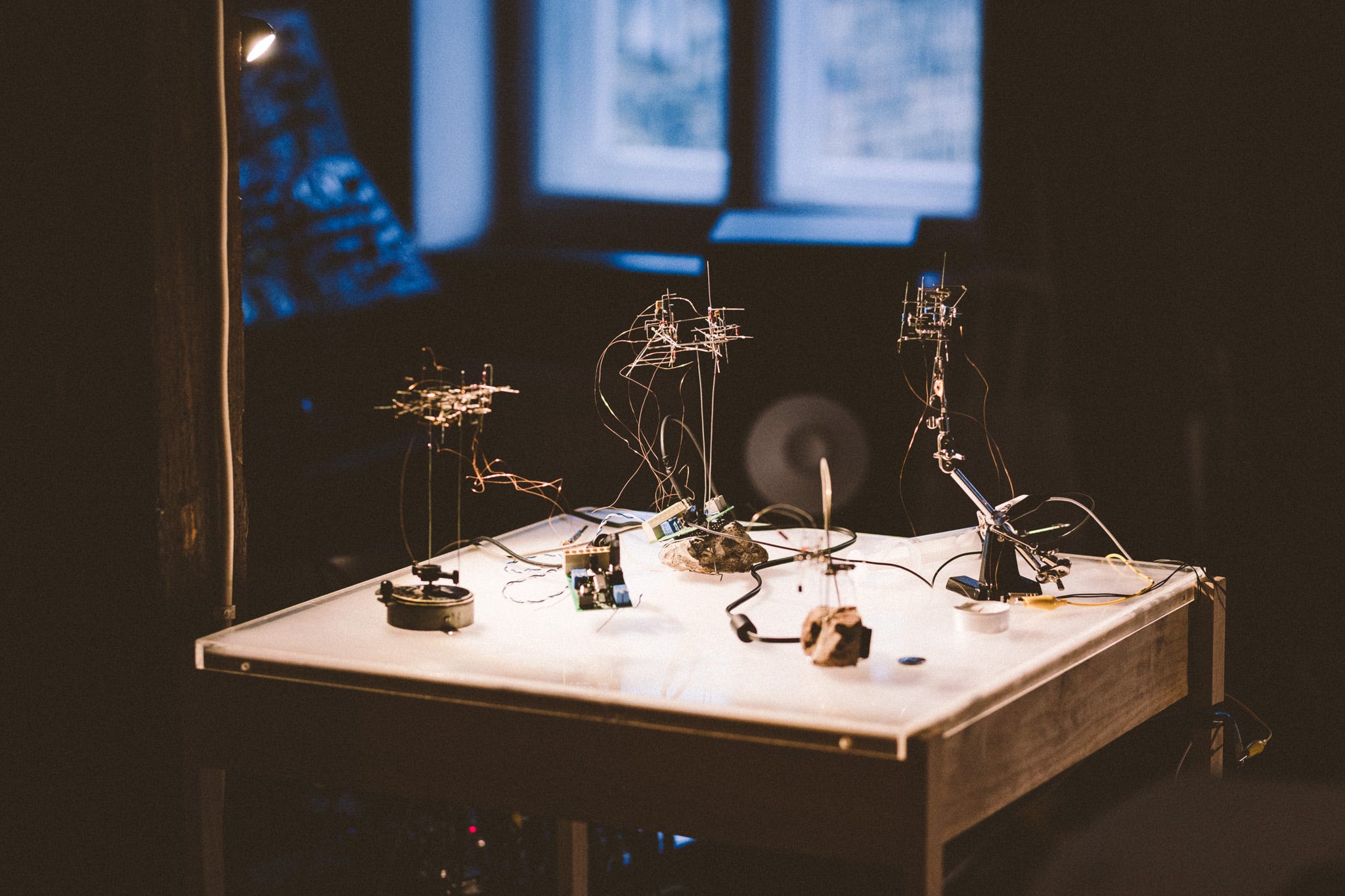
AP: The performance is built around what I call Circuits of Extended Phenotype: environmentally sensitised electronic instruments, synthesisers—simple in their form and operation, but extended in the sense that they accommodate environmental forces in their functioning. Many forces can enter, from heat, wind and outside vibrations to moisture, humidity and electrochemical processes. All of them accumulate to modulate the pitch, timbre, volume and function of the circuit itself. And this is made possible by having a liquid interface inside the circuit. That liquid—essentially, water—acts as an opening: it takes a rather rigid, closed electronic system and makes it malleable to other external energy inputs.
MI: So you’re literally placing water onto the circuit to start generating sound?
AP: Yes! Almost all the circuits I use are extremely primitive. I deliberately work with electronics stripped down to their most basic components. The functionality is simple, but all the composition, all the process, all the sonic activity you hear comes primarily from physically manipulating the circuit itself and the water that bridges it.
MI: These stripped-down electronics have almost a retrofuturist aura. They look rudimentary, like something I would find in my own grandfather’s flat. But the underlying processes within that simplicity are far from simple. The same applies to sound. Do you think consciously about that tension, between the plainness of the setup and the complexity of what it produces?
AP: That’s exactly it, I think. The whole premise is to bring out complexity through very simple means: simple electronics, simple circuits, simple designs. And then to invite the complexity that’s always already around—the physical surroundings, the environment—to shine through that interface. The simplicity is the opening. As for the aesthetics, some of it is quite pragmatic. To start playing with these things, I needed them without any outer casing, totally exposed. But that exposure also connects conceptually: the fragility of the instrument mirrors the fragility of the process. It can be started or ended with just a tissue, or accidentally knocked over. I think that functional necessity gradually became something more as I found new ways of playing it and started understanding its boundaries.
MI: Watching you wrestle with that fragility was exciting. There was a clear structure to your set, but also a real sense of openness and improvisation. Given how independent these processes are, you could sometimes arrive at a boring result. How much are you willing to intervene? What’s going through your mind on stage as these things unfold?
AP: I’d draw a parallel with playing in an improvised ensemble with other musicians. You can always intervene, and I do—steering things, pushing in some direction. But equally, I can sit back and let it breathe, without doing anything, because the process continues naturally on its own. Even if I did nothing at all, the water bridging the circuit would simply evaporate over half an hour or so, depending on the conditions. That evaporation would be a composition in its own right. I work very much through listening and intuition rather than execution. It’s more like a dialogue with the circuit: making small suggestions, sometimes without clearly knowing what’s going to happen. And I’m excited to take those risks. If you use ice, for instance, you have no idea where it’s going—every ice cube has its own distinct shape, its own way of melting. But you understand the instruments have their norms, their limits. They’re not going to explode (surprisingly!). And yet within those limits it can feel both completely limitless and strangely precarious. Sometimes during a performance I feel like I’m being trolled by the circuits: they just won’t work, and the whole thing becomes about making them work at all. And sometimes it’s the opposite: I’m trying to stop them, and they won’t stop.
MI: Have you ever had a performance that went really wrong, or didn’t work out as you’d hoped?
AP: Not a disaster, though disaster is always around the corner. Maybe the real disaster is when everything goes exactly as expected, when it’s just boring.
MI: Water seems like the foundation of your setup. How does it behave in a performance, and does the kind you use make a difference?
AP: Everything is happening at a very small scale, at the scale of a drop. That’s why the cameras are there, to bring it closer. I’ve even done performances where I zoom in on individual droplets, where you can see them bubbling. That bubbling is electrolysis: the current passing through is splitting water molecules. So there’s a constant process of charge transfer, which is thermodynamically dependent on temperature. And then there are solubles, electrolytes—they interact too. It also depends on what water I’m actually using. Tap water, ice, saltwater—they all behave differently. In principle, it can be any liquid solution, and different solutions produce different properties: different adhesion to the nodes, different effects on the sound. A change in any of these variables can introduce vibrato, alter the timbre or shift the whole character of what you’re hearing. All these little processes running simultaneously, each capable of having its own effect.
MI: And what about the use of a lighter?
AP: Heat is yet another way to alter the conditions within the drops. Heated molecules and atoms move faster—they carry the charge faster. At the same time, it quickens evaporation substantially. Together, these effects make it a double-edged trick: heat allows more current to flow, often lowering the pitch, yet the shrinking water connection restricts it, often raising the pitch.
MI: You even worked with kvass, a fermented drink made from black or rye bread, which I really enjoy but struggle to find in London. You sonified the fermentation process, didn’t you?
AP: Exactly. Kwassic Motion grew from the same research I did back at the Institute of Sonology in The Hague. Using electrochemical sensors, I measured the carbon dioxide and pH of kvass. The byproducts of its fermentation are carbon dioxide bubbling up and increasing acidity as lactic acid develops, giving kvass its taste. So I drove the entire composition through this process. It was also, in a way, connected to homesickness. Kvass is not easy to find in Western Europe, as you mentioned.
MI: The piece ended with a tasting session, which was a wonderful touch.
AP: Indeed, one of the key aims was to engage with the microbes through all our senses: from sound and smell to sight and, of course, taste.
MI: What’s next? Are there new materials, processes or ideas you’re exploring?
AP: Currently, I’m developing new instruments: a bit more hybrid, bringing together extended electronic approaches and some sample processing, dissecting digitally encoded material. And then there’s something quite different: a community project at Bala, a gallery in Vilnius. The idea is to invite people to bring their audio, video and other electronics—whatever they have—and learn to fix things together, promoting the practice of repair, reuse and creative activation of electronic appliances. Practically, it will operate like a repair café. After that, a small sound installation will emerge. I’m not entirely sure what it will become, because it really depends on what people bring. I don’t want to draw a clear line between the repair process and what becomes the installation. It grows from the activity itself.
MI: That repair café idea shares something with your performance work: an openness that invites other forces and presences to do the composing. Do you have a favourite collaborator amongst them?
AP: I think compositions exist on many different scales and levels: there’s a composition of music, of circuit diagrams, of tree root networks. And they all foster connections, transmit and link, whether ideas, nutrients or electrons. I’d like to regard my practice as attentive to these other non-human domains, and as inclusive and sympoietic (sympoesis means ‘to create with’) towards the environment. The repair café echoes this as well, but more as a countermove to the ever-growing consumption and production. Honestly, when I was invited to do a solo exhibition at the gallery, I just felt that this was not what the surrounding community needs at the moment. Eventually, I found my reason in this project instead. As for the favourite collaborator, let me ferment this question for a little longer…
Adomas Palekas’s upcoming repair café and installation takes place between 18 and 30 October 2026 at Bala Gallery in Vilnius. For more information, see the event details on Facebook or Instagram.